


Video
Historical Narrative
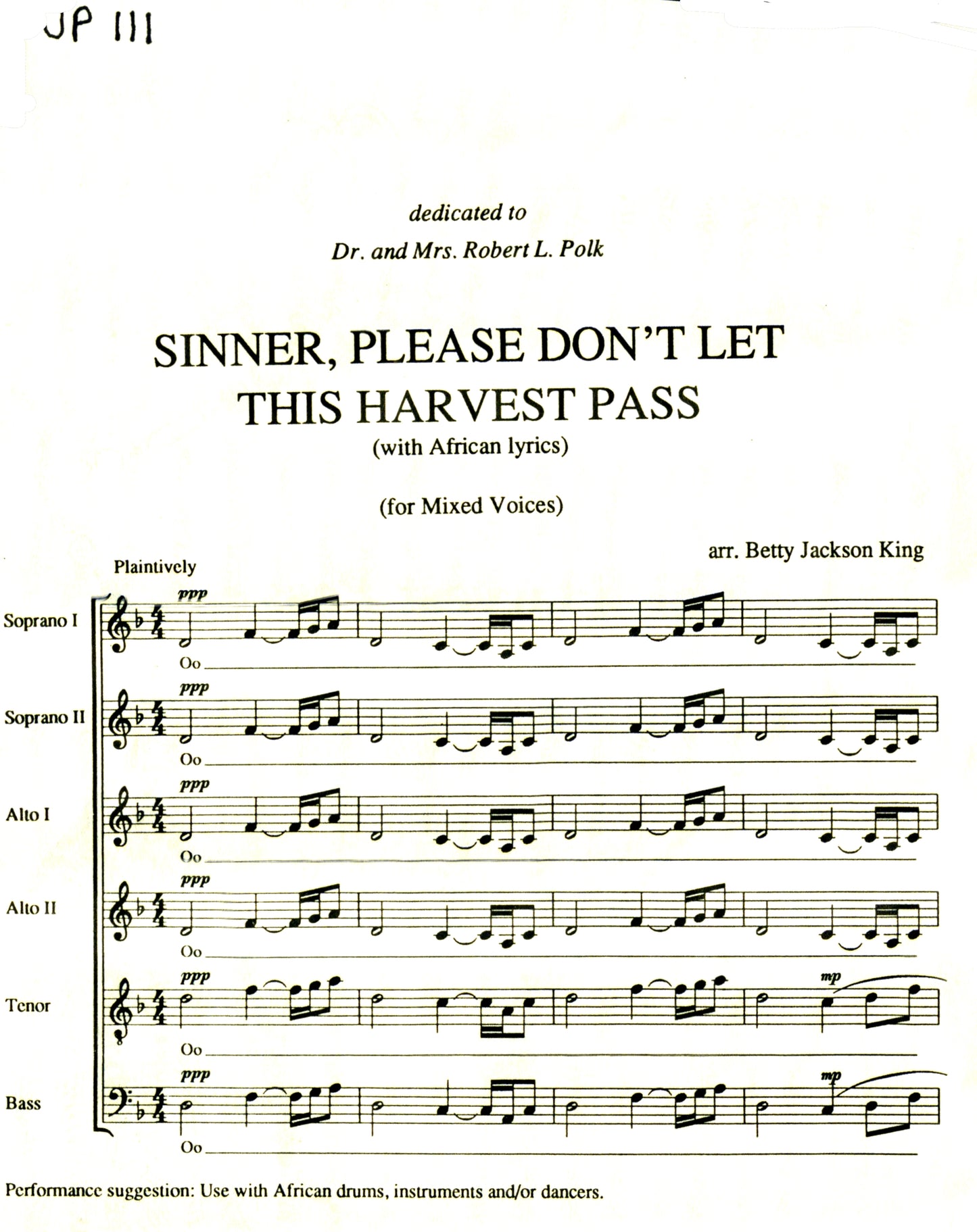
“Sinner, Please Don’t Let This Harvest Pass” was composed and copyrighted in 1978, during a highly productive period of Betty Jackson King’s compositional life. The dedication to Dr. and Mrs. Robert L. Polk reflects her long-standing connection with leaders in Chicago’s educational and religious communities who supported and shared her passion for sacred music. Dr. Robert L. Polk was a noted Chicago pastor, theologian, and educator who, along with his wife, was deeply engaged in both civic and musical life. Dr. Polk served as pastor of Good Shepherd Congregational Church (United Church of Christ) in Chicago and was well known for his ecumenical outreach and commitment to African American arts and culture. It is likely that he and Dr. King became acquainted through shared professional and denominational circles, as King herself served as Minister of Music at the Congregational Church of Park Manor and often collaborated with other Chicago-area clergy and musicians within the Congregational (UCC) tradition.
Both Dr. and Mrs. Polk were active supporters of the Chicago Music Association (CMA), Branch No. 1 of the National Association of Negro Musicians, Inc. (NANM, Inc.), which was founded in 1919 and served as the oldest and one of the most influential branches of NANM. The CMA brought together ministers, educators, composers, and performers who shared a mission to elevate African American music through education, performance, and scholarship. Betty Jackson King was a longtime member and eventually became National President of NANM (1970–1984). The Polks’ dedication in this composition likely commemorates their friendship with King and their mutual advocacy for music as both a cultural and spiritual force.
The dedication of “Sinner, Please Don’t Let This Harvest Pass” stands as a gesture of gratitude and mutual respect. Dr. and Mrs. Polk’s commitment to the Black church and to the development of young musicians in Chicago paralleled King’s own life’s work. Their names on this score connect them to a lineage of civic and musical leadership that shaped the spiritual and cultural foundation of Chicago’s Black artistic community.
Musical Description
“Sinner, Please Don’t Let This Harvest Pass” is arranged for mixed voices (S.S.A.A.T.B.) and marked “Plaintively.” Written in the key of F major, the piece opens with a quiet, chant-like texture built on sustained “Oo” syllables that enter sequentially across all voices. This overlapping entrance creates a contemplative soundscape symbolizing prayer and repentance. King’s use of modal harmonies and staggered rhythms establishes a feeling of spiritual urgency, as if the singers are collectively pleading for grace. The suggestion to perform with African drums, instruments, and/or dancers deepens the connection between African and African American sacred traditions, reflecting King’s awareness of cultural continuity within the spiritual form.
The second section introduces African lyrics—including “Ai-yeh,” “Kay-cym-bym gullum,” and “O-yan-dro”—sung in call-and-response patterns between voice parts. These phrases, combined with the English plea “Sinner, please don’t let this harvest pass,” create a powerful fusion of ancestral rhythm and Christian devotion. The music rises and falls in dynamic waves, maintaining emotional restraint while expressing deep spiritual urgency. Through this synthesis of Western choral style and African rhythmic vitality, King transforms the traditional spiritual into a timeless meditation on faith, redemption, and humanity’s connection to divine mercy.