


Video
Historical Narrative
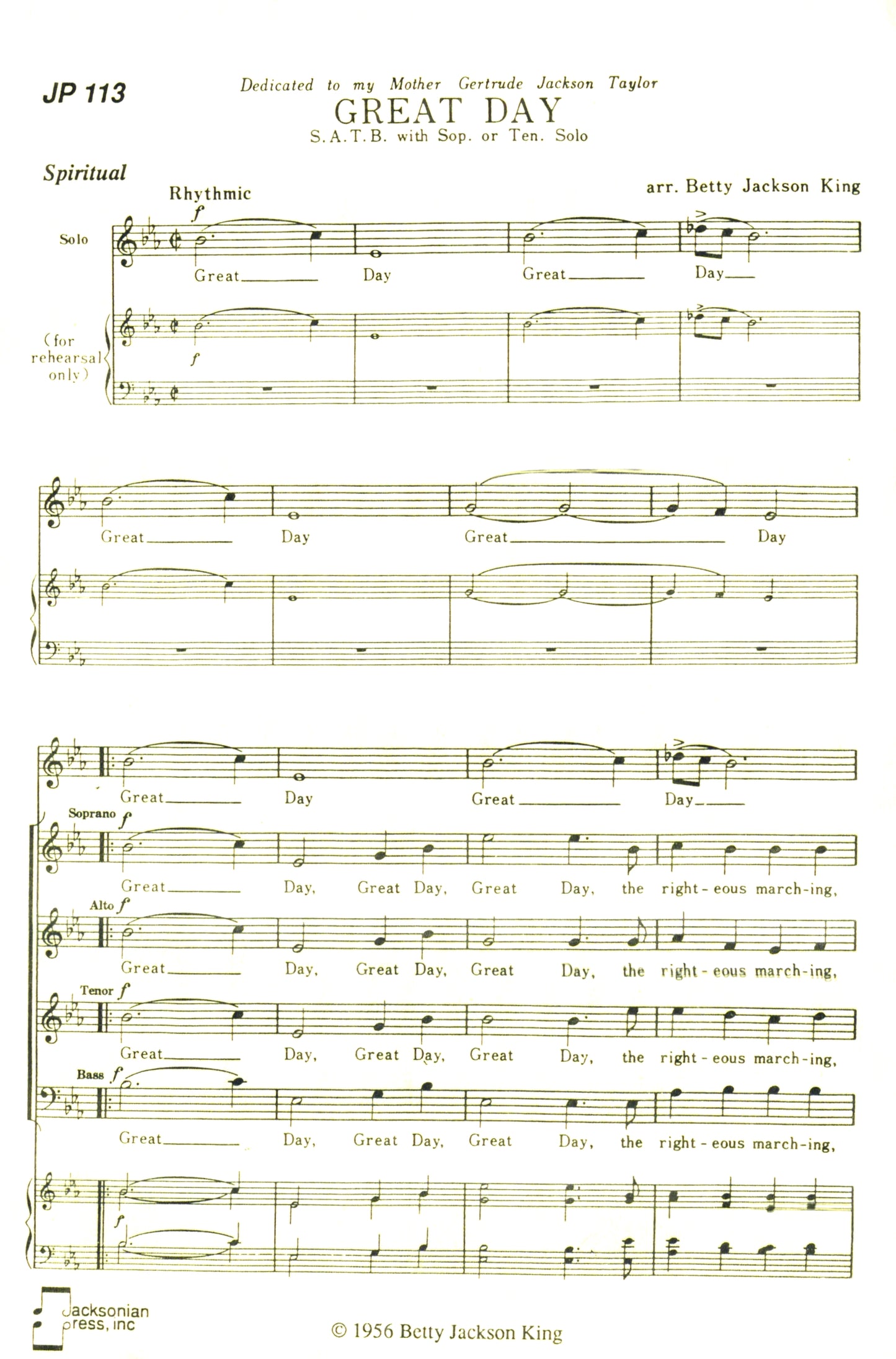
Betty Jackson King’s arrangement of the spiritual “Great Day” is dedicated to her mother, Gertrude Virginia Smith Jackson Taylor (1903–1995)—a pioneering musician, soprano, and founder of The Imperial Opera Company in Chicago during the 1920s. Gertrude Jackson Taylor’s vision for the Imperial Opera Company was groundbreaking: it offered opportunities for African American classical singers at a time when access to major stages was severely limited by racial segregation. Through this organization, she cultivated the careers of numerous artists and presented operatic works, recitals, and sacred music programs that advanced the visibility of Black concert performance in the Midwest. Her influence shaped the musical development of her daughter, Betty, who grew up immersed in the sound of rehearsals, vocal artistry, and the discipline of operatic training.
Beyond her accomplishments as a founder, Gertrude Jackson Taylor was active in Chicago’s church and community music scene, known for her commanding stage presence and her commitment to vocal excellence. Her work bridged the sacred and the classical, providing a foundation for Betty Jackson King’s lifelong mission to preserve, arrange, and elevate African American sacred music traditions. By dedicating “Great Day” to her mother, King not only honored her personal heritage but also celebrated the broader legacy of women who used music as a tool for empowerment, education, and cultural continuity. Taylor’s example of leadership and artistry continued to resonate through Betty’s compositions, choral direction, and advocacy for the preservation of spirituals as serious concert repertoire.
Musical Description
In “Great Day,” arranged for SATB with soprano or tenor solo, Betty Jackson King transforms the traditional spiritual into a dynamic, rhythmically engaging anthem of faith and triumph. Written in E-flat majorand marked Rhythmic and f (forte) at the opening, the piece begins with a solo voice—symbolizing the prophetic call of the spiritual tradition—before being answered by the full chorus. The harmonic foundation is solid and resonant, built on sustained chords in the lower voices that support the solo’s declamation of “Great Day.” The recurring text “the righteous marching” and “God’s going to build up Zion’s walls” are treated with rhythmic vitality and syncopation, capturing both the urgency and jubilation of the coming “great day.”
King’s hallmark harmonic language—lush, chromatic, and filled with gospel inflection—brings sophistication to the simplicity of the folk melody. She alternates between homophonic and antiphonal textures, creating a musical dialogue between soloist and ensemble. Dynamics range from forte declarations to pp (pianissimo) reflections, particularly in the closing section (“If you get there before I do…”), which offers an intimate, contemplative contrast to the earlier exuberance. The final return to “Zion’s walls” unites the voices in a peaceful yet triumphant affirmation. Both technically rewarding and emotionally stirring, this arrangement is ideally suited for concert, worship, or commemorative performance, embodying Betty Jackson King’s dual devotion to artistry and faith—and her deep reverence for her mother’s musical legacy.