


Video
Historical Narrative
Dedicated to Ethelynde Engram and the Die Lorelei Ensemble, this powerful arrangement for S.S.A. with Solo exemplifies Betty Jackson King’s ability to elevate the spiritual into a concert art form while preserving its emotional authenticity.
Ethelynde Engram was an accomplished musician, educator, and choral conductor who served as President of the Chicago Chapter of the National Association of Negro Musicians, Inc. (NANM) during the mid-1950s. Her leadership and advocacy for African American composers helped expand performance opportunities for women’s ensembles and fostered collaborations among Chicago’s leading church musicians, composers, and educators. The Die Lorelei Ensemble, an accomplished women’s chorus under Engram’s direction, was recognized for its artistry and interpretation of both classical and spiritual repertoire.
Betty Jackson King and Ethelynde Engram likely crossed paths through NANM’s Chicago Chapter, where both women were prominent contributors to the advancement of Black concert music. Written in 1956, Stan’ the Storm reflects the shared musical mission of these two visionaries—King as composer and Engram as performer—to uphold the sacred spiritual tradition while inspiring a new generation of trained musicians. This dedication represents both a gesture of friendship and an acknowledgment of Engram’s enduring influence on women’s choral music in Chicago’s mid-century Black classical community.
Musical Description
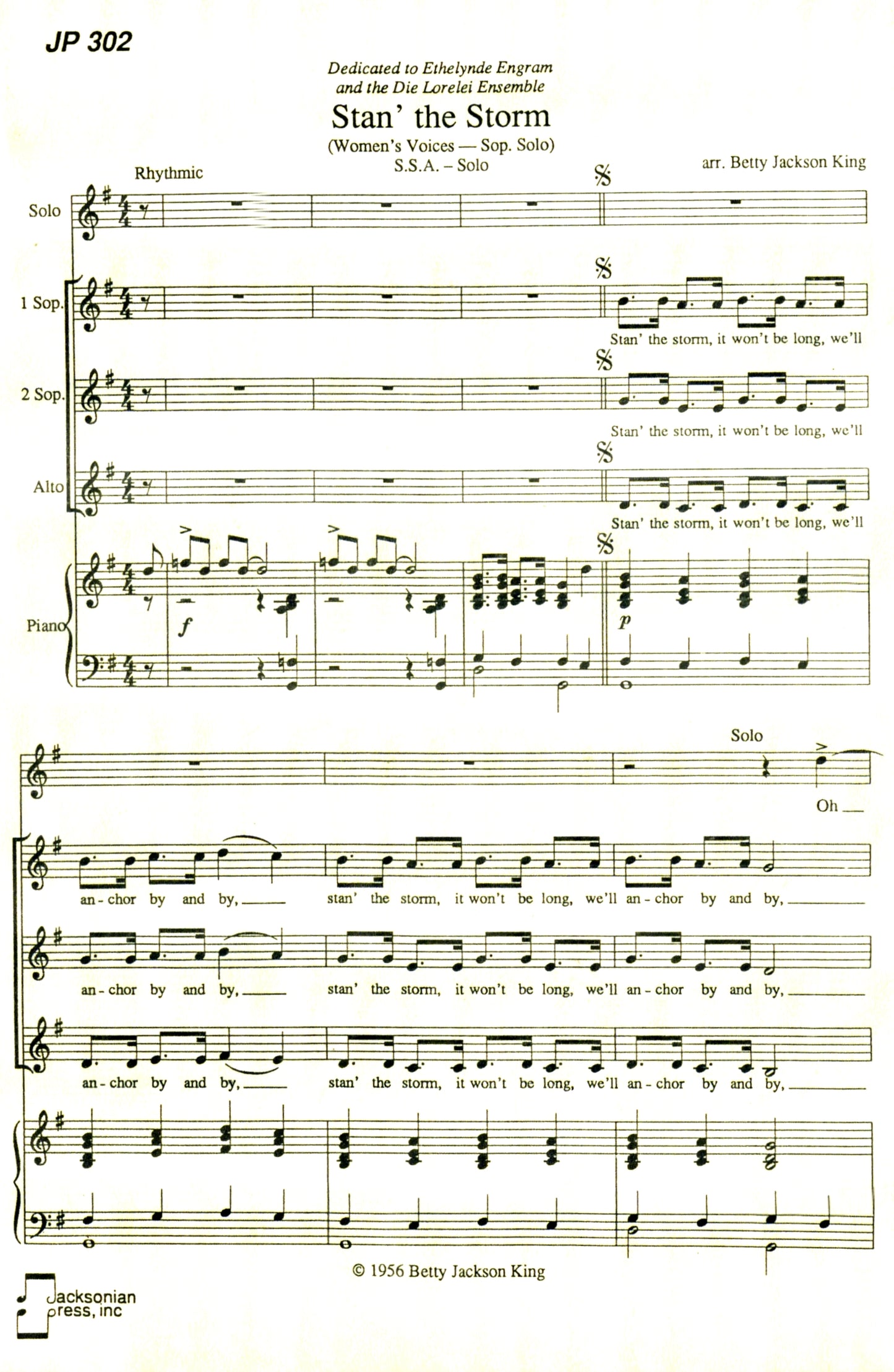
Written in E major (four sharps) and marked Rhythmic, this spirited arrangement opens with a driving accompaniment that sets an urgent, forward momentum symbolic of perseverance through life’s tempests. The texture alternates between asolo soprano voice and responsive choral interjections, embodying the call-and-response structure deeply rooted in African American sacred traditions.
King employs tightly syncopated rhythms and bright harmonic clusters in the upper voices to create tension and release, while the lower voices provide firm harmonic grounding. The recurring text “Stan’ the storm, it won’t be long, we’ll anchor by and by” is reinforced by pulsating rhythmic figures that mirror both the turbulence of the storm and the steady faith that anchors the believer.