


Video
Historical Narrative
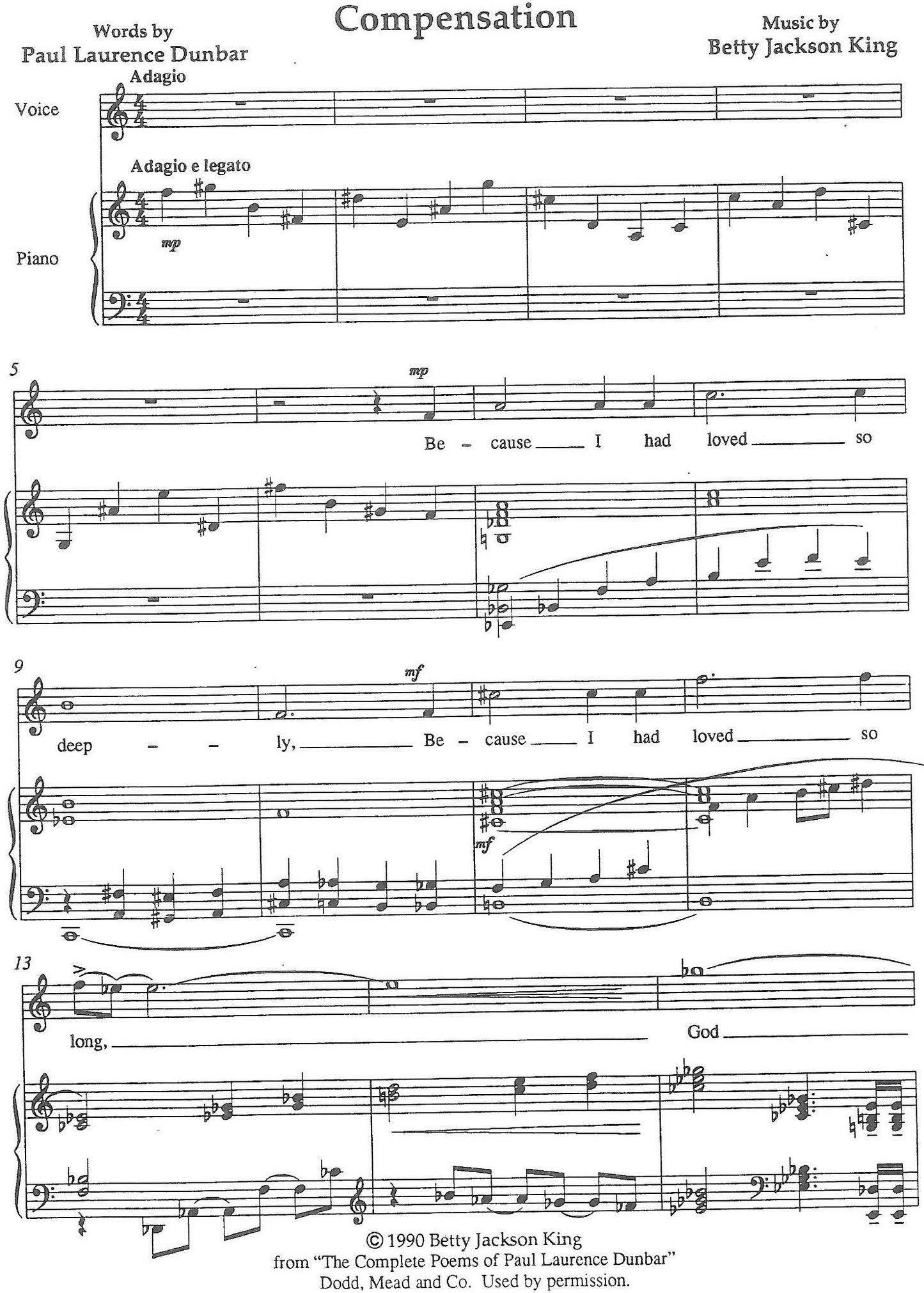
A Set of Three Dunbar Poems reflects Betty Jackson King’s deep commitment to African American literary heritage and her sensitivity to the expressive possibilities of art song. By setting poetry by Paul Laurence Dunbar—one of the most influential African American poets of the late nineteenth and early twentieth centuries—King aligns herself with a lineage of Black composers who elevated African American texts within classical concert traditions.
This work is dedicated to soprano Edna Williams, a respected soloist, educator, and arts advocate in Chicago. Williams was an active member of both the National Association of Negro Musicians, Inc. (NANM) and the Chicago Music Association, organizations that played a crucial role in fostering performance opportunities, professional development, and artistic excellence among African American musicians. Her participation in these organizations places her firmly within the same professional circles as Betty Jackson King, whose leadership and compositional output were closely tied to Chicago’s Black musical institutions.
As a solo vocalist, Edna Williams was known for her clarity of diction, expressive nuance, and command of text—qualities essential for the effective performance of Dunbar’s poetry. King’s decision to dedicate this set to Williams suggests not only personal and professional respect, but also a compositional intent shaped by Williams’s vocal artistry. The dedication affirms the collaborative relationship between composer and performer that was central to the mission of NANM and similar organizations: composers wrote with specific artists in mind, and performers championed new works by African American composers.
Through this song set, King contributes to the preservation and advancement of African American art song, uniting poetry, music, and performance practice within a culturally affirming and artistically refined framework.
Musical Description
A Set of Three Dunbar Poems is crafted for solo voice and piano, with vocal writing that emphasizes textual clarity, lyrical phrasing, and expressive immediacy. King’s approach to Dunbar’s poetry is attentive rather than ornamental; the music serves to illuminate the emotional contours and imagery of the text rather than overshadow it.
The vocal lines are shaped to support a trained soloist, requiring secure breath control, nuanced dynamic shading, and clear diction. King’s melodic writing often follows the natural inflection of spoken language, allowing the poetry to remain at the forefront. This compositional approach aligns well with Edna Williams’s reputation as a thoughtful interpreter of text-driven repertoire.
The piano accompaniment functions as an equal partner, providing harmonic color, rhythmic stability, and emotional subtext. Rather than virtuosic display, the piano writing enhances mood and atmosphere, reinforcing the poetic narrative and supporting the singer’s expressive intent. Subtle harmonic shifts and carefully placed contrasts reflect King’s refined musical language and her understanding of art song as an intimate, communicative form.
Taken as a set, the three songs offer contrast while maintaining stylistic cohesion. They are well suited for recital programming, academic study, and performance contexts that emphasize African American art song and literary collaboration. The dedication to Edna Williams underscores the work’s origins in a living performance tradition—one in which composer, poet, and performer are united through shared cultural purpose and artistic excellence.