


Video
Historical Narrative
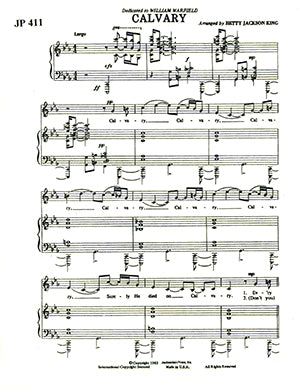
Betty Jackson King’s Calvary (1983) represents one of her most profound and emotionally charged arrangements of the traditional Negro spiritual. Dedicated to William Warfield, the internationally renowned baritone and interpreter of concert spirituals, this work exemplifies King’s ability to transform a simple spiritual melody into an expansive, symphonic expression of faith and suffering.
William Warfield (1920–2002) was among the most influential Black classical vocalists of the twentieth century. His career as a soloist, actor, and narrator extended from the concert stage to Broadway and film. Like King, Warfield was a champion of the spiritual as an art form worthy of concert presentation. His performances of works such as Ol’ Man River and Dat Suits Me showcased a deep understanding of the genre’s cultural weight and emotional sincerity. King’s dedication of Calvary to Warfield acknowledges his artistry and his lifelong commitment to preserving the dignity of African American sacred music in the classical tradition.
Composed during her late period, Calvary also reveals King’s mature harmonic palette and expressive pacing. It is a piece that demands vocal and emotional depth, qualities that reflect both Warfield’s interpretive power and King’s theological sensitivity.
Musical Description
Set in E-flat major and marked Largo, Calvary opens with a dramatic introduction of octave declamations and sustained chords, evoking the solemnity of Christ’s crucifixion. The piano establishes a slow, processional rhythm—anchored by dark, resonant sonorities and the indication sforzato to emphasize the gravity of the text. The voice enters quietly with repeated invocations of “Calvary,” each phrase lengthened by rests that create a sense of meditation and awe.
King’s vocal writing demands expressive control, combining lyrical legato lines with emotionally charged declamations. The dynamic contrast between pp (as in the opening vocal entrance) and ff (in the climactic “Surely He died on Calvary”) mirrors the progression from sorrow to triumph. Her use of repetition heightens emotional intensity—each recurrence of “Calvary” layered with harmonic variation and increasingly fuller accompaniment.
The accompaniment functions as both structural foundation and expressive commentary. Sustained chords in the left hand contrast with rhythmic triplets and accented block chords in the right, symbolizing the tension between human anguish and divine purpose. The middle section, with text such as “Every time I think about Jesus,” shifts into a more impassioned, rhythmic pulse, demanding both power and phrasing from the performer. The harmonic language moves through subtle modulations, employing secondary dominants and chromatic inflections that evoke deep pathos without losing tonal clarity.