


Video
Historical Narrative
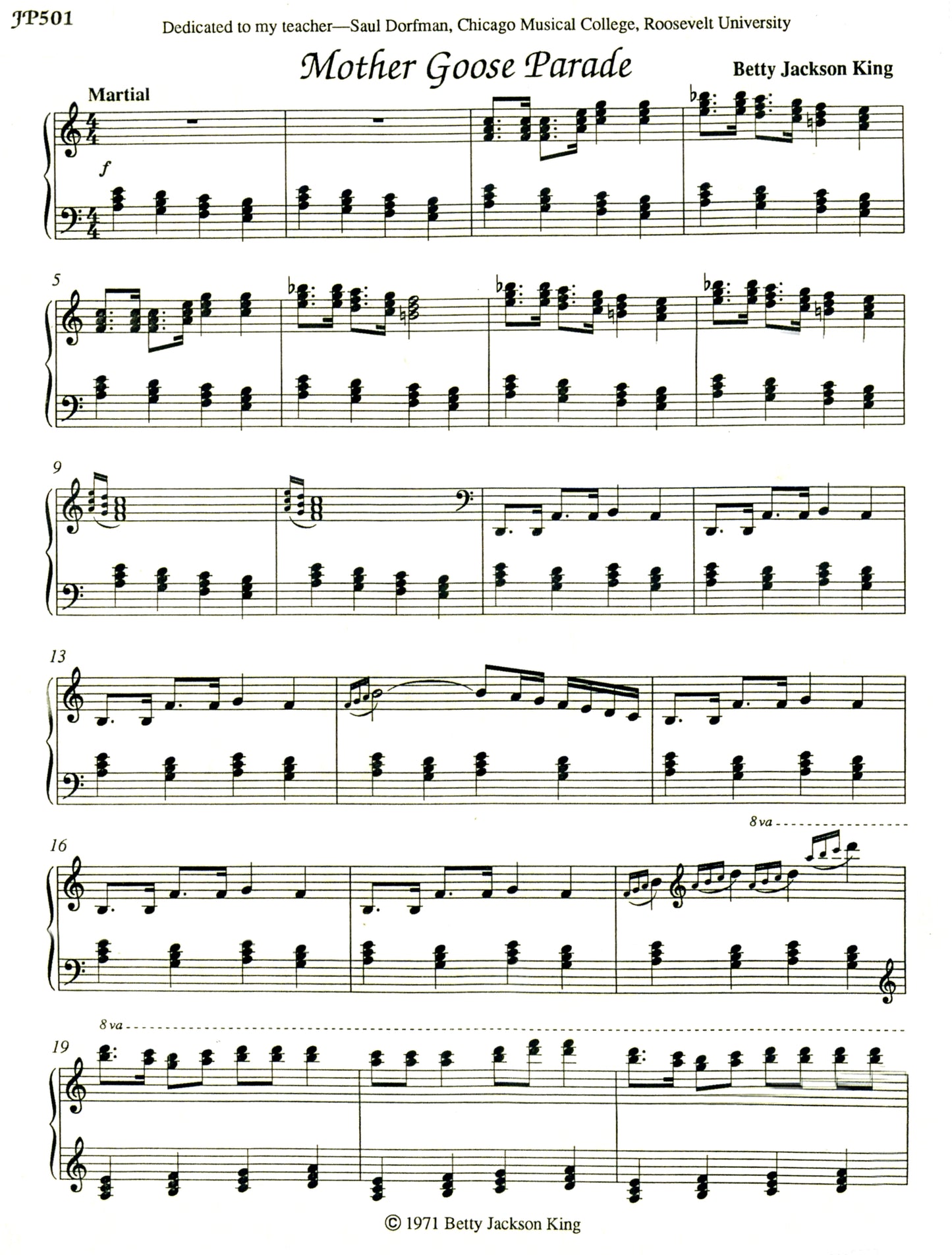
Mother Goose Parade occupies a distinctive place within Betty Jackson King’s piano output, reflecting her interest in pedagogical repertoire that balances technical development with imagination, character, and narrative play. Composed in 1971, the work was dedicated to her teacher, Saul Dorfman, a respected pianist and educator affiliated with Chicago Musical College at Roosevelt University, where King pursued advanced musical study.
Saul Dorfman was widely recognized in Chicago as a serious musician committed to pianistic discipline, clarity of articulation, and stylistic integrity. His pedagogical influence emphasized solid technique, rhythmic precision, and musical storytelling—qualities that resonate strongly in Mother Goose Parade. The dedication suggests a student-teacher relationship grounded not only in technical training but also in mutual respect for educational repertoire that speaks to younger performers without sacrificing musical substance.
While Chicago Musical College, Roosevelt University represents the most clearly documented institutional connection between Betty Jackson King and Saul Dorfman, available sources do not currently indicate formal affiliations beyond this academic context (such as joint professional organizations, published collaborations, or shared faculty appointments elsewhere). However, given Chicago’s tightly interconnected musical community during the mid-20th century, it is highly likely that Dorfman’s influence extended informally through performances, studio teaching, adjudication, and professional mentorship beyond the university setting.
Mother Goose Parade reflects this pedagogical lineage. Rather than functioning merely as a children’s novelty piece, the work demonstrates King’s belief—shaped by her teachers—that educational music should cultivate discipline, imagination, and expressive awareness simultaneously. The dedication to Dorfman situates the piece within King’s formative years and acknowledges the role of rigorous academic training in shaping her compositional voice.
Musical Description
Mother Goose Parade is a character-driven piano work that unfolds through a series of vivid musical gestures suggestive of motion, procession, and playful imagery. Marked by clear rhythmic profiles and contrasting sections, the piece invites the performer to engage both technical control and imaginative interpretation.
The opening presents a martial, parade-like character, driven by firm rhythmic patterns and chordal textures that establish forward momentum. King’s use of repeated figures, octave writing, and registral contrast creates a sense of spatial movement—evoking the visual image of characters passing by in sequence. These elements require precise articulation and rhythmic steadiness, reinforcing foundational pianistic skills.
Throughout the work, King incorporates dynamic contrasts, articulation changes, and textural shifts that challenge the performer to shape phrases with intention. Lighter passages contrast with more assertive chordal writing, offering opportunities for expressive nuance and tonal control. The music remains accessible to developing pianists while demanding careful attention to balance and clarity.
Harmonically, the piece is grounded yet colorful, using familiar tonal language enriched by subtle inflections that keep the musical narrative engaging. The concluding sections expand in range and energy, culminating in a confident, celebratory finish that reinforces the parade imagery.
As a pedagogical composition, Mother Goose Parade exemplifies Betty Jackson King’s ability to merge instructional purpose with artistic integrity. It is well suited for teaching repertoire, student recitals, and introductory concert programming, offering young pianists a musically satisfying work that fosters both technique and storytelling—principles clearly aligned with the pedagogical values associated with Saul Dorfman.