


Video
Historical Narrative
Composed in 1972, Psalm 57 (JP 104) stands among Betty Jackson King’s most reverent and introspective sacred choral works. Dedicated to the newly established Brazeal Dennard Chorale of Detroit, Michigan, this piece celebrates a union of artistry, faith, and cultural preservation shared by two distinguished leaders in American choral music. Both King and Dennard were lifelong members of the National Association of Negro Musicians, Inc. (NANM)—the nation’s oldest organization devoted to promoting and preserving music by African Americans.
At the time of this dedication, Brazeal Dennard, an accomplished conductor, vocalist, and educator, had just founded the Chorale (1972) to continue the tradition of excellence exemplified by his mentor William L. Dawson of Tuskegee Institute. Dennard would later serve as National President of NANM (1975–1980), while Betty Jackson King—already an influential composer, educator, and publisher—would follow in that same leadership role in the early 1980s. Their mutual commitment to sacred choral expression and the advancement of Black musicians created a natural artistic alliance. King’s dedication of Psalm 57 to Dennard’s ensemble thus reflects not only admiration for his musicianship but also a shared mission within NANM: to give voice to faith, heritage, and excellence through choral art.
Drawing its text from Psalm 57: 1, 7, 10–11, the work embodies the psalmist’s plea for mercy and steadfast praise—“Be merciful unto me, O God… My heart is fixed.” Written at a time when both King and Dennard were shaping the national dialogue around African American classical music, the piece serves as a bridge between worship and concert stage. Through this dedication, King honors a colleague and friend whose vision paralleled her own: to ensure that the music of Black composers would not only survive but continue to inspire generations of singers and listeners across America.
Musical Description
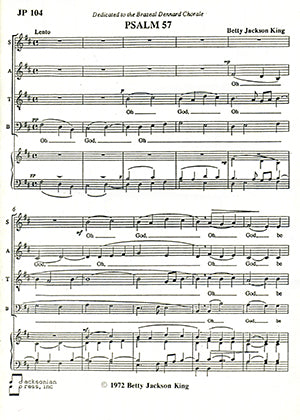
Scored for SATB choir with piano (for rehearsal only), Psalm 57 unfolds Lento (quarter = 60) in the luminous key of D major. The opening invocation, “O God, be merciful,” is tender and expansive—each voice entering gently in imitation, creating a tapestry of prayerful sound. The harmonic language is characteristically rich yet restrained, combining modal lyricism with expressive suspensions that evoke both humility and hope. King’s phrasing emphasizes breath, balance, and clarity, inviting singers to shape every line with reverent patience.
As the piece develops, the texture deepens through alternating passages of homophony and subtle counterpoint. The recurring plea “Be merciful unto me” rises and falls like a confession whispered and renewed, while controlled dynamic growth leads to a quiet, radiant close. The six-and-a-half-minute work demands tonal precision and emotional maturity rather than volume, offering choirs a profound meditation on faith and mercy.
A hallmark of Betty Jackson King’s sacred catalog, Psalm 57 exemplifies her union of classical structure and spiritual depth. It remains both a tribute to the artistry of the Brazeal Dennard Chorale and a testament to the enduring fellowship within NANM—where King and Dennard’s shared dedication to beauty, discipline, and divine purpose continues to resonate through generations of choral music.